AI news for UK small business: week 47, 2026
Anthropic goes public, Google slashes model prices, and ChatGPT opens up to businesses
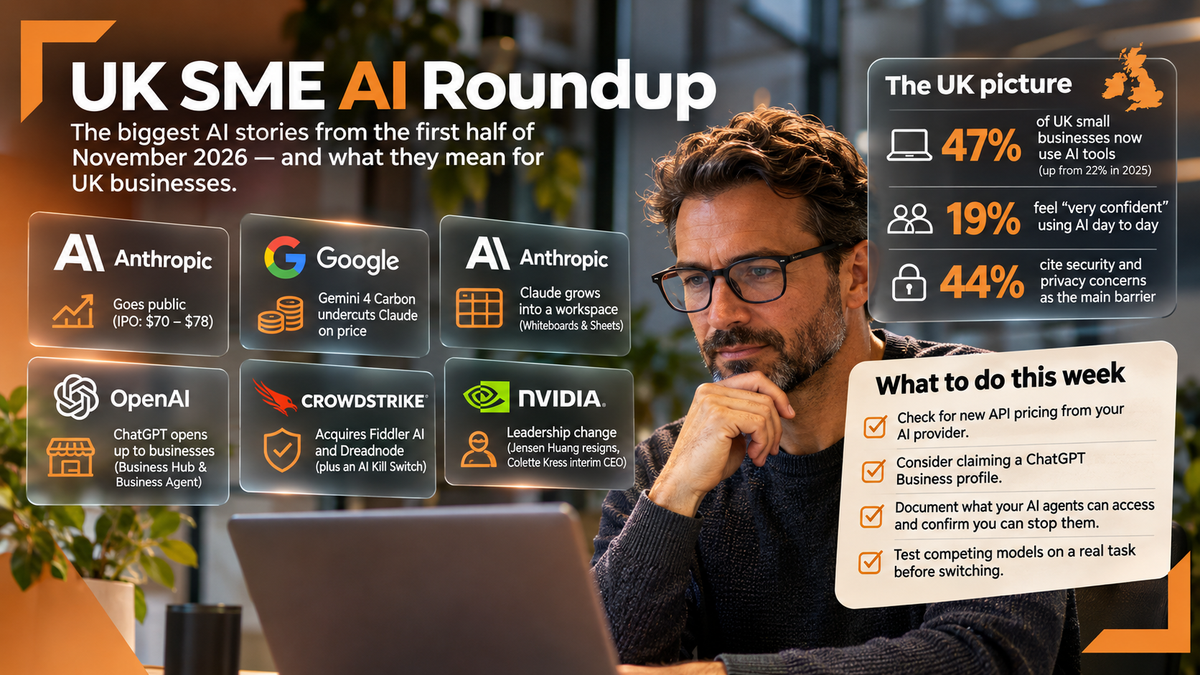
UK SME AI Roundup: Anthropic’s IPO, Google’s Price Challenge and the Rise of AI Agents
AI news and developments | 9–16 November 2026
What happened this week
AI is getting cheaper, more powerful and more deeply embedded in business operations. But as the opportunities grow, so do the risks. November's developments highlight an industry shifting from rapid experimentation towards commercial competition, wider adoption and greater accountability.
Google is putting pressure on AI pricing, Anthropic is preparing for a major stock market listing, and OpenAI is changing how businesses can be discovered through ChatGPT. Meanwhile, growing investment in AI security shows that controlling autonomous agents is becoming just as important as deploying them.
For UK SMEs, the message is clear: the opportunity isn't simply to adopt more AI, but to make better decisions about where to use it, what it costs and how to manage the risks. This week's developments offer some useful clues about where the market is heading.
Anthropic prepares to go public
Anthropic, the company behind Claude, has announced its proposed initial public offering (IPO), with an expected share price of $70 to $78.
The company plans to list on the Nasdaq stock exchange under the ticker ANT, with pricing expected on 18 November and trading anticipated to begin on 19 November, subject to the offering proceeding as planned.
Anthropic's financial disclosures also highlight the scale of growth in the AI industry. The company reported revenue equivalent to approximately £25.2 billion for the first nine months of 2026, compared with around £1.9 billion during the same period in 2025.
It's an extraordinary increase, although the company's substantial infrastructure costs demonstrate just how expensive developing and operating advanced AI models can be.
A publicly listed Anthropic would face greater financial scrutiny, potentially giving businesses more visibility into the performance and direction of one of the world's leading AI providers. For organisations already relying on Claude for coding, research or automation, this could provide a clearer picture of its long-term investment priorities.
Google challenges Claude on price
Google made Gemini 4 Carbon broadly available on 10 November, introducing aggressive pricing for its latest frontier AI model.
During the introductory period, which runs until 30 November, the API costs $2 per million input tokens and $10 per million output tokens.
From 1 December, those prices will increase to $4 per million input tokens and $20 per million output tokens.
For comparison, Anthropic's Claude Fable 5.2, released on 9 November, costs $8 per million input tokens and $40 per million output tokens.
That makes Google's introductory rates 75% lower than those of Claude Fable 5.2.
However, comparing AI models purely on token pricing doesn't tell the whole story. Some models require more processing, generate longer responses or take more time to complete a task. The cheapest model per token isn't necessarily the most cost-effective.
For businesses using AI APIs to power applications, customer service systems or automated workflows, increasing competition could help reduce operating costs. The sensible approach is to test alternative models against existing workloads, comparing accuracy, reliability, response times and the total cost of completing each task.
API prices are shown in US dollars, as published by the providers. Actual costs for UK businesses may vary depending on exchange rates, billing arrangements and applicable VAT.
Claude becomes more than a chatbot
On 10 November, Anthropic introduced Claude Whiteboards, Claude Sheets and Claude Data, bringing more collaborative features directly into Claude.
Whiteboards allows teams to brainstorm, organise ideas and develop plans together. Sheets provides spreadsheet functionality, including formulas, formatting and collaborative editing. Claude Data, previously known as Claude Dashboards, enables businesses to analyse information and create visual reports using connected data sources.
Whiteboards and Sheets are currently in beta, while Claude Data is generally available.
Anthropic acknowledges that its spreadsheet functionality is still relatively basic compared with established applications such as Microsoft Excel. However, the direction is clear: Claude is evolving from a conversational assistant into a broader working environment.
The features are available on paid plans, although organisations should review their settings. On Enterprise plans, Whiteboards and Sheets are disabled by default, while Claude Data is scheduled to become enabled by default on 20 November.
For smaller businesses, tools like these could reduce the time employees spend moving between different applications. A team could brainstorm a marketing campaign, organise the work into a spreadsheet and produce reports without constantly exporting and importing information.
Whether that convenience translates into genuine productivity improvements will depend on how well the features work alongside existing processes and data protection requirements.
ChatGPT introduces business profiles and insights
OpenAI announced Businesses in ChatGPT on 10 November, introducing a new way for companies to manage how they appear within ChatGPT.
Through Business Hub, eligible businesses can claim and verify their profiles, update business information and access aggregated insights into how customers discover them.
These insights include how frequently a business is mentioned, how many users click through to its website and the topics associated with customer discovery.
Importantly, businesses do not receive access to individual ChatGPT conversations. Insights are aggregated and only made available when sufficient activity meets OpenAI's privacy thresholds.
OpenAI has also introduced Business Agents, allowing participating companies to provide interactive product and service information to customers.
However, Business Agents are currently limited to eligible ecommerce and online service businesses in the United States. Eligible UK businesses can use the broader Business Hub claiming process, but cannot yet launch Business Agents through this initial programme.
This announcement is particularly interesting for businesses that rely on online discovery. Customers increasingly use AI assistants to research products, compare suppliers and decide which companies to contact.
Traditionally, businesses have concentrated on improving their visibility through Google and other search engines. AI assistants introduce another potential route for customers to discover products and services.
For UK SMEs, claiming an eligible Business Hub profile and keeping online business information accurate could become an increasingly useful part of their digital marketing strategy.
AI agent security becomes a serious business
Earlier in November, CrowdStrike announced plans to acquire Fiddler AI and Dreadnode, two companies specialising in AI monitoring, testing and security.
The combined acquisitions were reported to be worth approximately £376 million, highlighting the growing commercial importance of securing AI systems.
Fiddler AI focuses on monitoring and explaining the behaviour of AI agents, while Dreadnode specialises in identifying vulnerabilities through security testing.
CrowdStrike also introduced an AI Kill Switch within its Falcon Guardian platform. The feature gives authorised administrators the ability to stop an AI agent, prevent it from restarting and restrict its network access if it begins behaving unexpectedly.
The announcement reflects an important shift in how organisations need to think about AI security.
Unlike traditional chatbots, AI agents can interact with applications, retrieve information, process data and carry out actions automatically. That creates opportunities to improve productivity, but it also introduces new risks.
Even relatively simple business automations can have access to sensitive information, customer records or internal systems. As more organisations introduce agents for customer enquiries, email processing and administration, understanding what those agents can access becomes essential.
Clear permissions, activity logging and a reliable way to stop an agent should be part of any implementation. These are practical safeguards that businesses can introduce without necessarily investing in expensive enterprise security platforms.
Nvidia announces a major leadership change
On 12 November, Nvidia announced the resignation of Jensen Huang as president, chief executive officer and a member of its board.
Colette Kress, Nvidia's long-serving chief financial officer, has been appointed interim CEO while the company searches for a permanent successor.
Harvey C. Jones has also become the company's first board chair.
The leadership change comes at a significant time for Nvidia, which remains one of the most influential companies in the global AI industry. Its processors and computing infrastructure underpin many of the systems used by leading AI developers and cloud service providers.
Nvidia is scheduled to publish its third-quarter fiscal 2027 financial results on 17 November, providing an early opportunity for investors and customers to hear about the company's direction following the announcement.
Nvidia has indicated that it expects operations, customer commitments and its product roadmap to continue without interruption.
Most UK SMEs won't purchase Nvidia's most powerful AI processors directly, but many rely on cloud services built using its technology. Any significant changes in Nvidia's strategy, product availability or infrastructure investment could eventually influence the cost and availability of AI services.
For now, there is no immediate reason for businesses to change their plans, although organisations considering major AI infrastructure investments should continue monitoring developments.
The UK picture: AI adoption is growing faster than confidence
While technology companies continue introducing new capabilities, recent research suggests UK businesses are still working out how to use AI effectively.
According to the Simply Business 2026 SME Insights Report, 47% of UK small businesses surveyed now use AI tools, compared with 22% in 2025.
However, only 19% of respondents describe themselves as very confident using AI in their day-to-day work.
Security and privacy are also significant concerns, with 44% of business owners identifying them as barriers to adoption.
Separate research from the British Chambers of Commerce, published in March 2026, found that 54% of UK firms surveyed were actively using AI.
Interestingly, 95% of SMEs using AI reported that it had not affected workforce size during the previous year.
The surveys use different samples and methodologies, so their adoption percentages are not directly comparable. Nevertheless, both point towards growing AI adoption across UK businesses.
What stands out is the gap between access to AI and confidence in using it.
Businesses can subscribe to ChatGPT, Claude, Copilot or Gemini relatively easily. Getting employees comfortable with the technology, understanding data protection requirements and identifying where AI will genuinely improve operations is more difficult.
For many SMEs, practical training and a clear adoption strategy could deliver more value than simply purchasing additional tools.
The businesses that benefit most are likely to be those that integrate AI into existing processes, measure the results and make sure employees understand both its capabilities and limitations.
What should your business do this week?
With so many developments taking place, it's easy to feel that your business needs to react to every announcement. In reality, a few practical steps are likely to deliver more value than constantly switching between tools.
- Review your AI costs. If you use API-based AI services or automated workflows, check whether recently released models offer better value. Compare total operating costs rather than simply looking at the advertised price per token.
- Check how your business appears in ChatGPT. Investigate whether you can claim your business profile and review the accuracy of the information available about your company.
- Review your AI agents and automations. Make sure you understand what each agent can access, what information it processes and how to disable it if something goes wrong.
- Test models before switching. Whether you're considering Claude, Gemini, ChatGPT or another platform, use real business tasks to compare performance, reliability and cost.
- Invest in employee confidence. Provide practical AI training, clear guidance on data protection and opportunities for employees to experiment with approved tools.
The bigger picture
The developments of November 2026 show how quickly the AI industry is evolving. Competition between providers is increasing, AI tools are becoming more deeply integrated into everyday business activities, and security companies are responding to the risks introduced by autonomous systems.
For UK SMEs, the biggest opportunity isn't necessarily adopting the newest AI model or investing in the latest platform.
It's understanding where AI can save time, reduce costs, improve customer experiences and help employees work more effectively.
The technology is becoming increasingly accessible, but successful adoption still requires the right approach, appropriate safeguards and a clear understanding of what the business wants to achieve.
AI is becoming easier to access. The real competitive advantage will come from knowing how to use it well.
Keep reading
AI News Roundup
UK SME AI Roundup: Bank of England Growth Data, ICO Agentic Scrutiny and OpenAI's Image Upgrades
This week's roundup